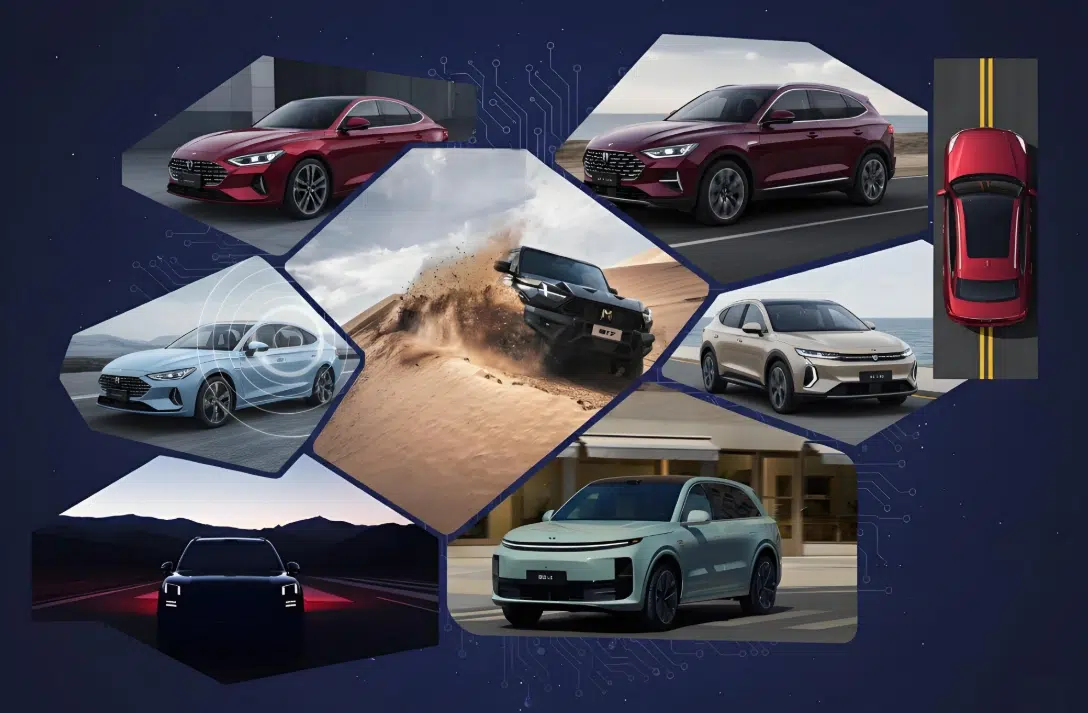
China today is the world’s largest EV market, with more than 60 active Chinese EV brands and manufacturers on the road. Living here, it’s impossible to miss the change. The streets are full of cars with green license plates, marking new energy vehicles (NEVs). On ride-hailing apps like Didi and Gaode, almost every ride is in an EV, much like Uber abroad. Parking lots, both outdoor and underground, are lined with charging stations, showing how fast the infrastructure has expanded.
This transformation reflects strong government support. After the real-estate boom, Chinese EV companies became a strategic priority, backed by supportive policies and capital. The result is a landscape where global leaders like BYD, NIO, XPeng, and Geely grow alongside state-owned manufacturers such as Changan, Dongfeng, and Chery, as well as major private groups like GWM, while dozens of smaller startups keep entering the field.
We sort the market into three tiers: Leading, Established, and Niche & Emerging. This makes it easier to understand who is leading, who is reliable, and who is still proving themselves.
Scope note: This directory focuses on Chinese electric passenger car brands. Commercial vehicle makers such as Yutong and King Long, which specialize in buses and trucks, are not included. Tesla, while a major EV seller in China, is also excluded because it is not a Chinese automaker. For coverage of Tesla and other international players, see our Global EV Manufacturers 2025: Popular Brands by Country.
Last updated: September 29, 2025. We review this directory quarterly and update immediately on major events (new launches, mergers, restructurings).
Chinese Electric Car Brands — Updated List (68 Brands)
This 2025 update presents a complete directory of Chinese electric car brands and manufacturers, now covering 68 entries. The directory is organized into three tiers: Leading brands, Established brands, and Niche & Emerging brands, with concise tier definitions.
Note on Tesla: It’s often mentioned in the same conversation, but Tesla isn’t a Chinese brand, so we focus this section on China’s leaders.
When people talk about Chinese electric car brands, the first names that come up are BYD, MG, Geely, NIO, XPeng, Li Auto, Aion, and Wuling. These companies set the pace with scale at home and credible export footprints. Here are quick facts to sit neatly beside your models table.
BYD sold 4.27 million NEVs in 2024, the most worldwide. Its electric cars are now sold in 70+ countries across Europe, Asia, the Middle East, and Latin America. The brand’s success also comes from its pioneering hybrid system — BYD DM-i technology, designed to make hybrid driving effortless and efficient.
MG (SAIC) ranked inside Europe’s monthly top-10 brands multiple times in 2024–2025, according to JATO. Its leading position here is driven by European scale and name recognition.
Aion (GAC), a value-oriented brand popular beyond China’s tier-one cities, sold about 375,000 vehicles in 2024. Its Thailand plant came online in July 2024, localizing production for Southeast Asia.
Most of the Chinese EV brands above aren’t standalone companies — they sit inside larger automotive groups, either state-owned or privately controlled. Understanding those ties is the fastest way to read China’s electric-vehicle market.
For example, Changan houses Deepal, Nevo, and Oshan; Dongfeng runs Aeolus (Fengshen), Forthing (Fengxing), and eπ (Yipai); and SAIC manages Roewe, Maxus, and Rising Auto.
Decades of manufacturing, national dealer networks, and shared R&D make these sub-brands stable and scalable, even if they’re not household names abroad.
Private giants follow a similar multi-brand playbook.
Geely operates Zeekr, Geometry, Lynk & Co, and the Galaxy series, covering everything from value to premium. GWM balances rugged pickups under the GWM/Poer line and retro-styled city EVs through ORA, with WEY as its upscale arm. Chery pushes upward with Exeed and tech collaborations such as LUXEED.
These companies may not have state ownership, but they iterate quickly and aim abroad.
Alongside them are newer, tech-leaning players — Leapmotor, Neta, AITO (a Seres × Huawei brand), and Xiaomi Auto. Volumes are smaller, but software-first features, urban design, and fast refresh cycles keep them in the conversation.
Together, these brands form the backbone of China’s EV ecosystem. Not all will break through internationally, but the group structures behind them make their programs durable — and grouping by ownership and strategy is the quickest way to see who’s who and who’s likely to stick around.
This category covers smaller EV makers/companies, from Brilliance Xinri and Dayun Auto to more experimental names like EV House or Lingbox. Many of these brands launch just one or two models, often affordable micro EVs or low-cost city cars for second- and third-tier cities, and they face higher survival risks compared with larger manufacturers.
EV House (Chongqing) is a small Chinese EV manufacturer that launched the EV House Yue 01, a city EV designed for budget-conscious young buyers in lower-tier markets. Like many emerging brands and companies, its strategy is highly regional.
Zhidou (Geely umbrella) focuses on micro EVs like the Zhidou Rainbow. Recognition is limited outside local markets.
Brilliance Xinri developed a small EV primarily to support franchise/dealer recruitment, so volumes remain very limited.
Dayun Auto, originally a truck manufacturer, pivoted to a handful of passenger EVs, for example the Yuanzhi M1, but sales are still niche.
Within big groups, Fangchengbao and Yangwang (both under BYD) target specialized high-end niches such as off-road SUVs and showcase supercars rather than volume.
Many niche brands are experimental. A few could graduate into the Established tier if capital, product-market fit, and export readiness line up. Many others will merge, be acquired, or fade. For consumers and dealers, these names are interesting but higher-risk than the larger groups.
20+ Chinese EV Brands That Faded Away
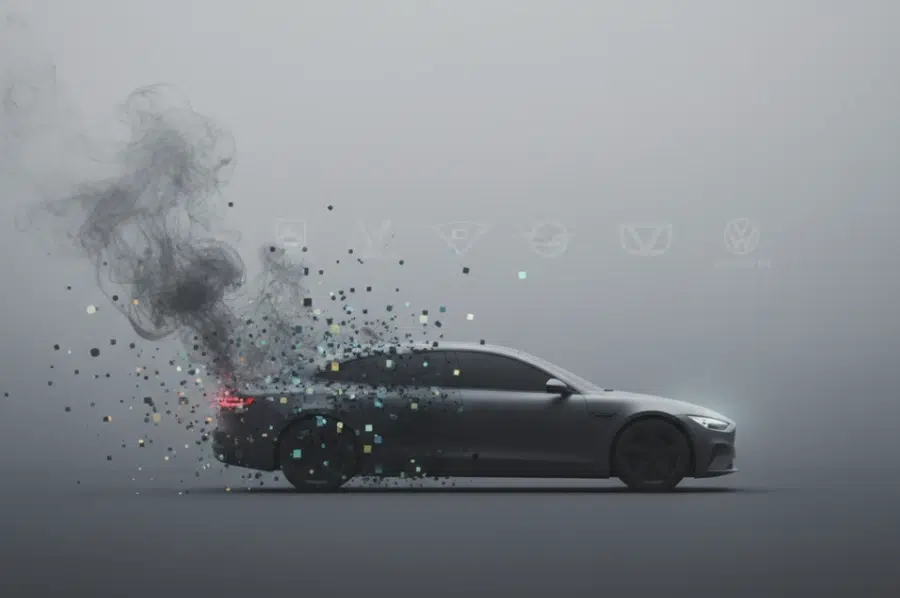
China’s EV boom has produced more than 100 brands and companies over the past decade, but not all of them survived. The market has always had a high attrition rate. Some ambitious manufacturers like WM Motor and Aiways went bankrupt or restructured, while others such as Yudo were acquired and rebranded.
This section highlights 20+ Chinese EV brands that shut down, restructured, or simply faded away, focusing on those with available data and identifiable models.
Bankrupt & Restructured
WM Motor (威马) – Once a high-profile startup with models like the EX5 and EX6, it stopped production in 2023. By 2024, it entered bankruptcy restructuring, with factories closed and assets frozen.
Dorcen (大乘汽车) – Produced models such as the GS60S and G70S, but officially went bankrupt in 2022. Its facilities have since been taken over by others.
Levdeo (雷丁) – Famous for low-speed EVs, it filed for bankruptcy in 2023. In 2025 it attempted a small revival with the Levdeo Mango Pro micro EV, but the brand remains marginal.
Aiways (爱驰) – Exported the U5 and U6 to Europe, but halted production in 2023. In 2024 it announced a full exit from the Chinese market to focus on exports, while pursuing a SPAC merger in the US.
Yudo (云度新能源) – Built the Yudo π1 and π3, but ceased production in 2023. Later acquired by Juneyao Group and rebranded as Jixiang Auto, which launched the Jixiang Air compact EV in 2025.
Failed Startups
Singulato (奇点汽车) – Its iS6 never reached mass production. The company collapsed and was declared bankrupt.
Enovate (天际汽车) – Launched the ME5 and ME7, but by 2023 had suspended all operations and stopped paying staff.
Bordrin (博郡汽车) – Went under in 2020 after running out of cash, with the iV6 project abandoned.
Xiaohu Auto (小虎) – Briefly released the Xiaohu EV in 2022 before disappearing.
Weiao Auto (未奥) – Introduced the Weiao BOMA micro EV in 2023, but operations ended the same year.
Hengrui Auto (恒润) – Built the HRS1 SUV and H23 sedan in 2022, but quickly exited the market.
Disappeared or Marginalized
Salon (沙龙, GWM sub-brand) – Tried to enter the luxury segment with the Mecha Dragon in 2022, but the project was suspended.
Yujie (御捷新能源) – Known for the Punk Duoduo and Punk Meimei micro EVs in 2022, which failed to gain traction.
Jiangnan Auto (江南汽车) – Attempted a revival with the Jiangnan U2 in 2023, but sales remain weak.
Haima (海马) – Released the 7X-E compact MPV in 2022, but the brand has largely faded from relevance.
Soueast (东南汽车) – Offered the SEM Delica and DX8S in 2022 before shutting down.
Caocao Auto (曹操汽车) – Presented the Caocao 60 compact EV in 2023, but is shifting focus to ride-hailing services rather than consumer EVs.
Evergrande Auto (恒驰) – Launched the Hengchi 5, but delivered only a symbolic number of units. With Evergrande Group’s financial collapse, its EV arm is essentially paralyzed.
Key Takeaway
China’s EV boom fueled rapid growth, but it also came with a high failure rate.
Dozens of brands, from once-hyped startups to traditional carmakers that failed to adapt, have disappeared.
The companies that remain strong are those with scale, funding, and technological strength.
Conclusion
China’s EV industry is diverse and constantly moving forward. Leading brands like BYD, Aion, NIO, XPeng, Li Auto, MG, and Wuling dominate sales at home and are now appearing more often abroad. On recent trips we have already seen Chinese EVs such as the MG4 and BYD Atto 3 on European streets, while Wuling’s small EVs are becoming common in Southeast Asia.
For consumers in China, EVs have already become the default choice, from ride-hailing fleets to family cars. For international dealers and partners, the message is clear. The safest opportunities lie with leading and strong established brands that have the scale, technology, and export capacity to endure.
The China EV market is not only the largest in the world but also one of the most influential. These brands are shaping the global future of electric mobility, and the real challenge is to know which ones will still be thriving five years from now.
We will continue to track updates from the China EV market and refresh this directory regularly.
FAQ about Chinese EV Brands
What are the top Chinese EV brands in 2025?
BYD, MG (SAIC), Geely (incl. Zeekr/Geometry/Lynk & Co), NIO, XPeng, Li Auto, Aion (GAC), and Wuling (SGMW). See “Leading Brands” for quick context.
Is Tesla a Chinese EV brand? Why isn’t it in this list?
No. Tesla is a US automaker. This directory focuses on Chinese electric car brands; we analyze China’s local leaders and emerging names.
Q: Why isn’t Tesla included in this directory?
A: Tesla is one of the top EV sellers in China, but it is an American automaker. This directory is limited to Chinese brands. For Tesla and other global EV makers, see our Global EV Manufacturers 2025 article.
How many Chinese electric car brands are there in 2025?
Over 60 active names in China’s market (this directory currently tracks 60+), but activity changes with launches, restructurings, and exits.
Which Chinese electric car brands are most visible outside China?
BYD and MG lead broadly; Zeekr, NIO, XPeng and SAIC Maxus appear across Europe; GWM (ORA/WEY) and Wuling are active in Southeast Asia and selected Middle East markets. Availability varies by country.
Best Chinese electric SUVs for families (2025)?
Li Auto L7/L9 (EREV), BYD Song/Sealion series, NIO ES6/ES8, XPeng G6/G9, Geely Galaxy L7, and Aion V. Check local export specs—they can differ from China-market trims.
Brian Peng is an automotive sales professional working with SinoAutoGo, focusing on Chinese vehicles for export markets.
He shares practical articles on Chinese EVs, hybrids, and EREV models, based on daily work with vehicle products, specifications, and overseas buyer inquiries. His writing aims to help international distributors and buyers better understand Chinese car brands, powertrain technologies, and model differences from a real-world sales perspective.